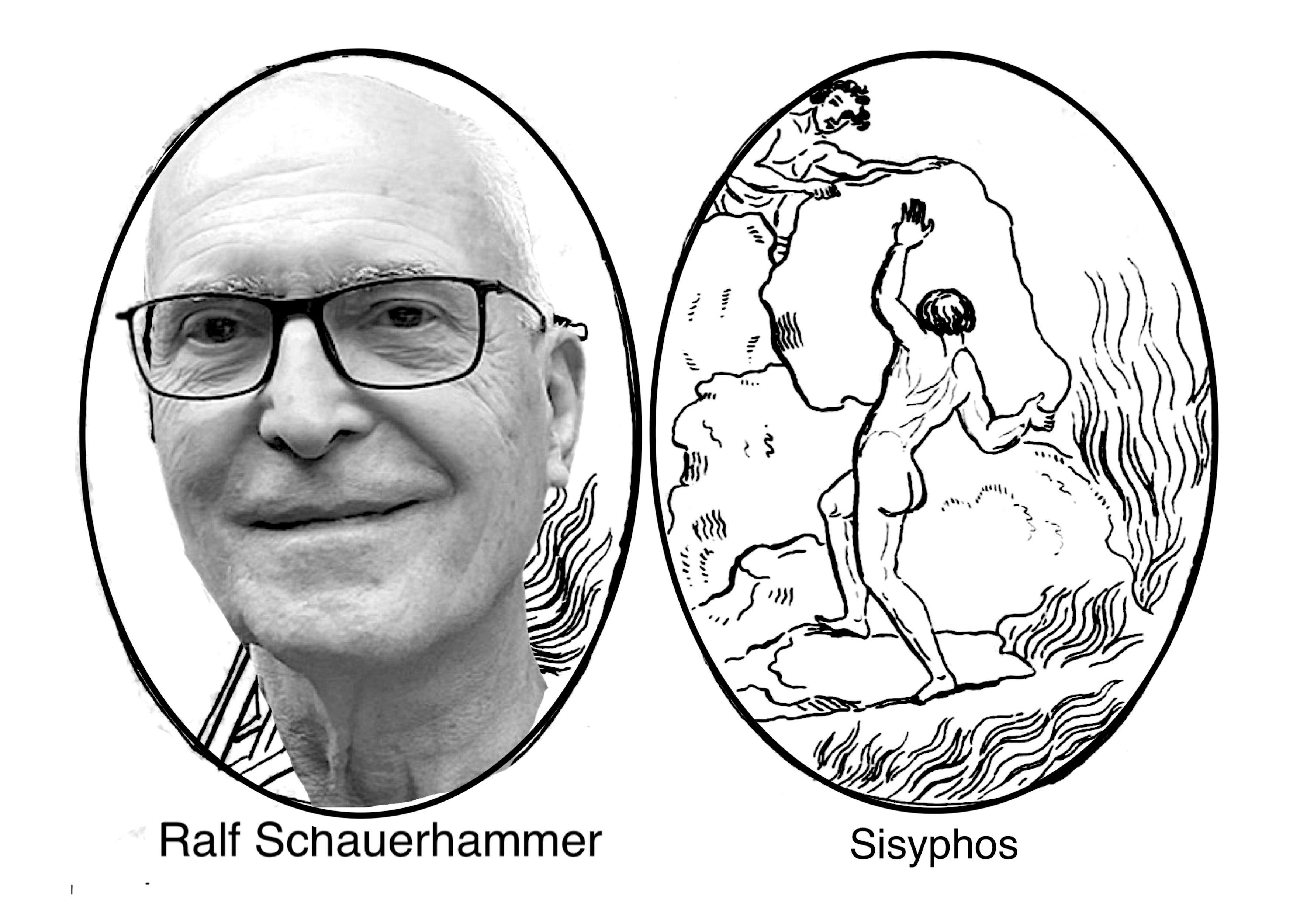
The heavy rock he rolls up the slope, again, again and again. Without any help, he is on his own, but never does he relent,
even though whenever he’s close to his goal the rock will fall back down the hill. He plays this seemingly pointless game as though it was the most natural thing.
Once, when the rock rolled down yet again, slipping away from his sore hands, out of pity I advised Sisyphus that he now should end his torment.
“Not can I stop”, says he, “that is the meaning that fate has prepared for me. Suffer gracefully I must, for in this way a role model for all in pain I will be.
It is not what you expect from life that counts, it is what life expects of thee. And this is, though it be painful, the purpose of existence for me.”
As though ‘t were the most natural thing, the stone he then took in his hand. In tears I watched, but full of joy, what Dignity is did comprehend.
Ralf Schauerhammer, born in 1949, is a German IT engineer and consultant, and with his twin-brother Lutz the co-founder of the poet‘s association „Dichterpflänzchen“ (Little Sprouts of Poetry). He has published a series of poems and essays in a number of books.
Ralf Schauerhammer, a native of Jena, Germany, was chairman of the Fusion Energy Forum and editor of its German-language journal, Fusion-Technology and Science for the 21st Century. He has authored numerous articles on science and environ-mentalism, and his 1991 book ‘Sackgasse Oekostaat, kein Platz fuer Menschen’ (Dead end-The environmental state: No room for human beings), was a best-seller in Germany.